
The conversation around AI in agencies often focuses on automation – saving time, cutting costs, or replacing repetitive work.
But the real opportunity isn’t just efficiency – it’s enhanced performance.
AI can help your team think faster, communicate better, and execute with more precision. The key is not to replace people but to augment them – building an agency that operates like a high-performance system.
In this post, we’ll break down the five core areas where AI can meaningfully improve team productivity and how to implement it strategically (without overwhelming your workflows).
1. Knowledge Sharing & Access
Information silos kill momentum. Every time your team asks, “Where’s that deck?” or “Who has the latest SOP?”, you lose compounding hours.
AI Solution:
- AI Knowledge Assistants like Notion AI or Guru can surface relevant documents instantly, summarize SOPs, and answer procedural questions in real time.
- Internal Chatbots can connect to Slack or Teams to handle FAQs, project details, or onboarding queries.
Result: Teams spend less time searching – and more time doing.
2. Automating Repetitive Tasks
Your team’s creative capacity should never be wasted on admin.
AI Tools in for Agency Tasks:
- Zapier + OpenAI: Automate client reports, proposals, or lead summaries directly from your CRM.
- ClickUp Brain or Asana AI: Auto-summarize meetings, assign next steps, and track project progress.
- Fathom or Fireflies.ai: Generate transcripts and action items from every client call.
These small automations compound over time – saving hundreds of hours annually while keeping projects moving.
3. Content Creation & Ideation
AI isn’t about outsourcing creativity, it’s about accelerating it.
Use AI for Content:
- Brainstorming: Use ChatGPT or Jasper to generate new campaign ideas, hooks, or positioning angles.
- Drafting: Tools like Copy.ai or Claude can handle first drafts of blog posts, emails, or ads.
- Refinement: Leverage AI editors for tone consistency, grammar, and structure.
The key is human editing and judgment. The best agencies treat AI as a junior creative assistant – not a creative director.
4. Client Communication & Reporting
AI can transform how you communicate insights, making client reports faster, smarter, and more strategic.
AI in Clients Comms:
- Automated Dashboards: Use AI-enhanced platforms like DashThis or DataBox for real-time campaign visibility.
- Report Summarization: Generate concise monthly summaries with narrative context (what worked, what didn’t, and why).
- Client Chatbots: Offer 24/7 access to campaign performance data – without manual updates.
This not only boosts productivity but enhances perceived professionalism and transparency.
5. Decision Intelligence & Forecasting
AI’s biggest advantage lies in its ability to detect trends and surface insights that humans might miss.
Practical Use Cases:
- Financial Forecasting: Use tools like LivePlan or Pry to simulate growth scenarios based on campaign performance or new client pipelines.
- Resource Allocation: Predict utilization trends to optimize staffing and delivery timelines.
- Deal Analysis: For acquisition-minded agencies, AI can model deal scenarios, flag risk factors, and estimate post-merger synergies.
By combining human intuition with AI-powered analysis, you elevate decision-making from reactive to predictive.
The Real Productivity Shift: Human + Machine Collaboration
The future of productivity isn’t about automation – it’s about augmentation.
AI frees your people to focus on what only humans can do: strategy, creativity, and connection.
When implemented intentionally, AI doesn’t just make your agency faster, it makes it smarter.
It builds a system that compounds knowledge, eliminates friction, and scales output without scaling chaos.
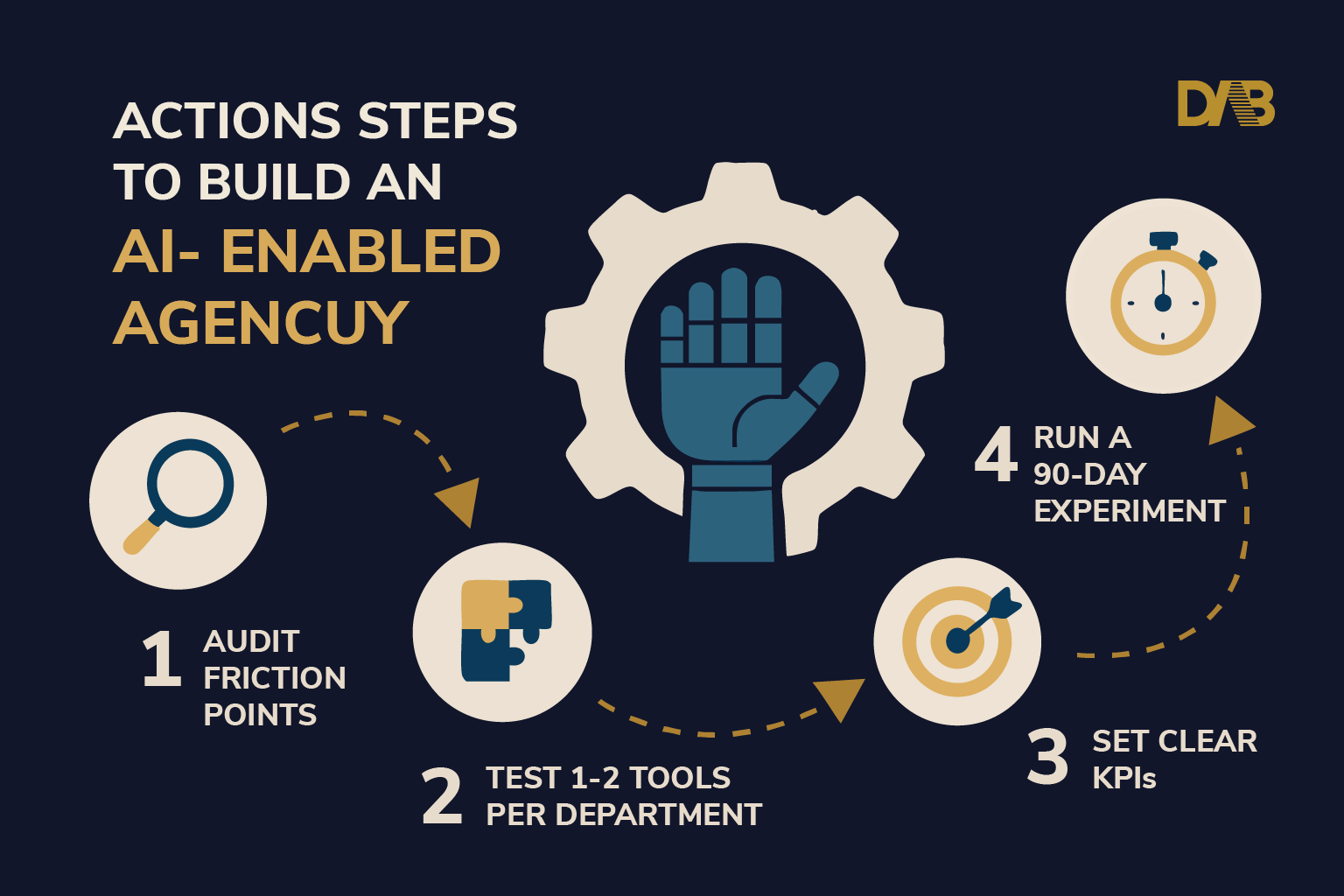
Action Steps:
- Audit your team’s recurring tasks and identify 3 areas of friction.
- Choose 1–2 AI tools to test per department – marketing, ops, and finance.
- Set clear KPIs (time saved, turnaround speed, client satisfaction).
- Run a 90-day experiment and measure the ROI.
AI isn’t a trend. It’s the new foundation for agency productivity and those who systemize it first will have the real advantage.