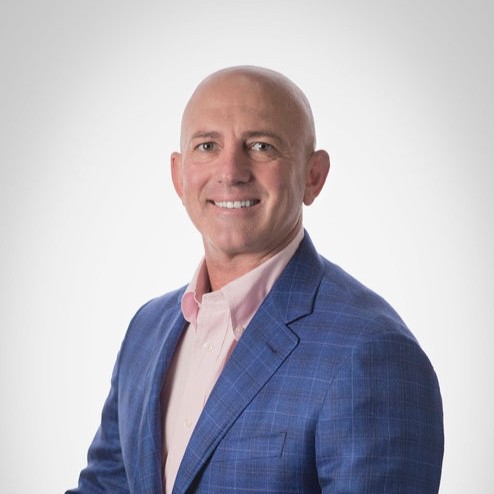
Aaron Gaeir started his first company with a phone, a small apartment in Las Vegas, and a copy of the yellow pages.
He was fresh out of college and had just left a pharmaceutical sales job at McKesson in San Diego. A friend had won the contract to build bus shelters in Las Vegas and needed someone to sell the advertising on them. Aaron was the first hire.
"I said, well, I'm young enough. I have a good enough resume. I can always come back. You don't get very many of these opportunities."
So he packed his bags, moved, and started cold-calling businesses out of the phone book to advertise on bus shelters.
That company sold to Lamar, the largest publicly traded out-of-home operator in the country. It was the first of four liquidity events across roughly two and a half decades: a taxi-top media business in San Francisco sold to Clear Channel on a strong earnout, a preventative healthcare media company called Leap Media sold to Cigna, and finally Grandesign — the out-of-home buying service he founded and grew past $50 million — sold to UK-based Talon Outdoor in 2019.
Today he runs GDX Studios, the experiential business he kept and built after the Talon deal, and he's openly preparing it for a fifth.
What makes the conversation useful isn't the deal count. It's that Aaron can explain, in plain terms, the operating philosophy that produced all of them.
Every Decision Measured Against One Thing
Grandesign had a stated goal from the start: build to $50 million. But the number wasn't the framework. Enterprise value was.
"All of our decisions were based on what's attractive for enterprise value. Diversity, profitability, top line, bottom line, diversified portfolio, recurring revenue. How we hired, every decision we made was based on what's attractive for enterprise value."
The filter he uses is a 30-30-30: 30 on the top line, 30 on the bottom line, 30 on portfolio diversification.
And the point he makes about it matters more than the numbers themselves. Building for enterprise value wasn't a sale-prep exercise. It was how he ran the business regardless of whether a sale ever happened.
"We believe that's what made a great company, whether we sold or not. It was a great way to recruit. It was a great way to retain employees."
He's equally clear about what he won't build.
"I don't want to be in the commodity business." Even in categories most people would call commoditised media, he wouldn't start anything without what he considered a clear competitive advantage. At Grandesign, that advantage was offering an out-of-home buying service with guerrilla marketing, what the industry now calls experiential, as an in-house capability.
A goal is a number. A framework is what you apply to every hire, every client, and every line of the P&L in the years before you get there.
This Year's Profit, or Next Year's?
Aaron poses a question to founders.
"If you're going to sell a company, what do you think's more powerful? Your revenue and your profitability today, or what it will be next year?"
Most people say today. He thinks that's wrong.
"It's not what you do today, it's what you're gonna do that I think is super important."
His view is that plenty of founders have genuinely good businesses with strong current profitability, and they feel attractive because of it, but they have no clear path into next year and the year after. Recurring revenue is the simplest version of the fix. Predictability. Templates for scale, from org charts to management to margins to diversification.
Peter framed the same idea from the buy side: you buy a business for present value with future expectations. And those future expectations are team-driven, not founder-driven.
Aaron's counterweight to all of that planning is worth sitting with, because it's the opposite of what the frameworks imply.
"Show me a business plan and a business that follows that business plan, and I'll show you a failed business, because life never goes to the plan."
You need the plan. You need the strategy. But what you need more, in his experience, is nimbleness and confidence in the team, because it will change.
I Don't Fire People. My People Fire People.
This is the line that reframes everything else Aaron says about culture.
He isn't describing a soft environment. He's describing one with a self-enforcing standard.
"If you can't keep up, they just ostracise you. They just say, well, that's not how we do it here. And they don't reprimand you, they just won't include you."
That only works if the culture is genuinely lived rather than laminated. In Aaron's environment it takes about a year before someone can credibly say I know how it's done, let me tell you how it's done and why. It can't be rushed.
He's honest about the cost of that.
"Companies like ours are difficult to scale quickly. But they also have a more solid foundation for growth."
And he flags the trade-off in his own words, repeatedly: his best trait is his worst trait. The culture he loves is impossible to sustain without growth, because the people it attracts want to be on a winning team. So growth isn't optional. It's the price of the environment.
He calls those people PLUs — people like us.
The hardest part of building an acquirable business isn't the systems. It's the management and motivation of people, and Aaron will tell you it's ever-evolving and never finished.
Filling Buckets, and Paying for Value Instead of Hours
Aaron's personal framework predates all of the companies: three buckets — personal, professional, financial. He works out how to fill his own, and he builds businesses that fill his team's.
The most concrete expression of it is how he pays people.
He recounts a conversation with an executive running a billion-dollar company who was courting Grandesign as a buyer, and who was confused by something on the org chart. Two people, same job. One he saw constantly. One he almost never saw. The one he never saw earned double.
The executive's objection: we pay for 40 hours, I expect a full-time employee to put in the time.
"I said, well, that's the difference. We pay for value, we don't pay by the hour. And that girl knows that that girl makes double, and that she can too — but she wants to be the head of the PTA and the softball coach of her daughter's team. That comes with transparency."
That transparency is deliberate, and it runs from day one. Aaron shares profitability with his team and operates the business openly, which he also points out makes his companies unusually good acquirers.
"We are perfect for buying companies, because things like transparency, that most companies are scared of, we embrace."
He is also unsentimental about why he does it. He argues it's simply more profitable.
"For the profit guy, the guy that doesn't care, I believe that this model of employee retention, recruitment, transparency, authenticity, entrepreneurial environment, in the end produces more money for the money guy."
At Close, the Onus Moves to the Buyer
Peter asked the question every acquirer eventually asks: a high-culture team is a positive attribute, but a buyer has to integrate it — the good parts and the difficult ones. How did Aaron think about handing his people to a new owner?
His answer is that he'd already done the work upfront.
When a prospective buyer walks into the room, his team doesn't scatter. They've been trained from day one that this day was coming.
"They're prepared to say, I can't wait till you ask me what I do, how I do it, why I'm here. They don't run and hide. Who's my boss? Do I have healthcare? What's going to happen now? Do I get fired? All of those things never happen with my companies. They embrace it."
Which means the retention problem transfers cleanly.
"The onus is back on that buyer to fill those buckets. If you want to retain the PLU talent, then all you have to do is one thing — which is difficult but also easy. You just have to help them fill buckets."
Are you growing the company? Are you mentoring these people? Are you increasing their value on their resume? Are you giving them flexibility and autonomy based on value rather than time?
And if you don't, he's blunt about the outcome: the best talent gets complacent and leaves.
"I've already vetted that out with those people. And then the onus is on you, the buyer, not on me. You know the playbook, right?"
Aaron's read is that most acquirers can state the rules they intend to live by, but nobody knows whether they'll actually hold until after close.
Why He Sold Grandesign, and What He's Doing Now
The reason Aaron sold in 2019 wasn't a number. It was a ceiling.
"At that time we were too big and we needed bigger shoulders. We needed more infrastructure to continue to scale. We could have run a lifestyle business, we were close to $50 million and profitable and did very well. But I couldn't continue to scale. I needed the bigger shoulders to fill buckets. So it was time."
Talon fit because the people fit. Aaron and Talon founder Eric Newnham had similar backgrounds and similar philosophies, and remain friends.
GDX is now in a comparable position, and Aaron is candid about the timeline. He works in two-year horizons and reassesses annually. On his read of the market and the business, GDX is well positioned for a partnership or liquidity event within the next 12 to 18 months, with the intention of testing the market before then. Meanwhile the company is moving from purely organic growth, he cites four consecutive years around 30%, into acquisitions of its own.
As for why he's still doing this at all, at 56, with four children at home: the honest answer he gives is that the driver isn't him.
"The biggest driver for me is spoiling people. My family, my kids, my parents, my friends, to be able to give them something they never would let themselves dream of."
Which is what makes the enterprise value framework more than a spreadsheet exercise.
"There's always a number that gives you the flexibility and autonomy that I hope takes care of my family so that I can sleep well."
And after that, he says, the plan is mentoring and board seats. Helping other people fill their buckets.
"No longer as the founder, but as the cheerleader."
You can build the frameworks on paper. Aaron's point, made twice in the conversation, is that they don't count until you go live them.
Listen to the Full Conversation
Hear Aaron Gaeir explain how he went from selling bus shelter ads out of the yellow pages to four exits across out-of-home, healthcare and experiential media, why he measures every decision against enterprise value, how his team is prepared for a buyer long before one shows up, and why he believes the transparency most companies fear is the thing that makes them worth more, on the Agency Acquisitions & Exits Podcast.