
Ask most agency owners what "success" looks like and they'll describe the same thing: one well-run agency, healthy margins, a good team, a life that doesn't require them in every client call.
That's a real accomplishment. It's also a ceiling.
Because a single agency, no matter how well it's run, has a hard limit on what it's worth and how much risk it carries. One bad year with your biggest client. One key hire who leaves. One market shift that dents your niche.
You feel all of it, immediately, because it's the only business you have.
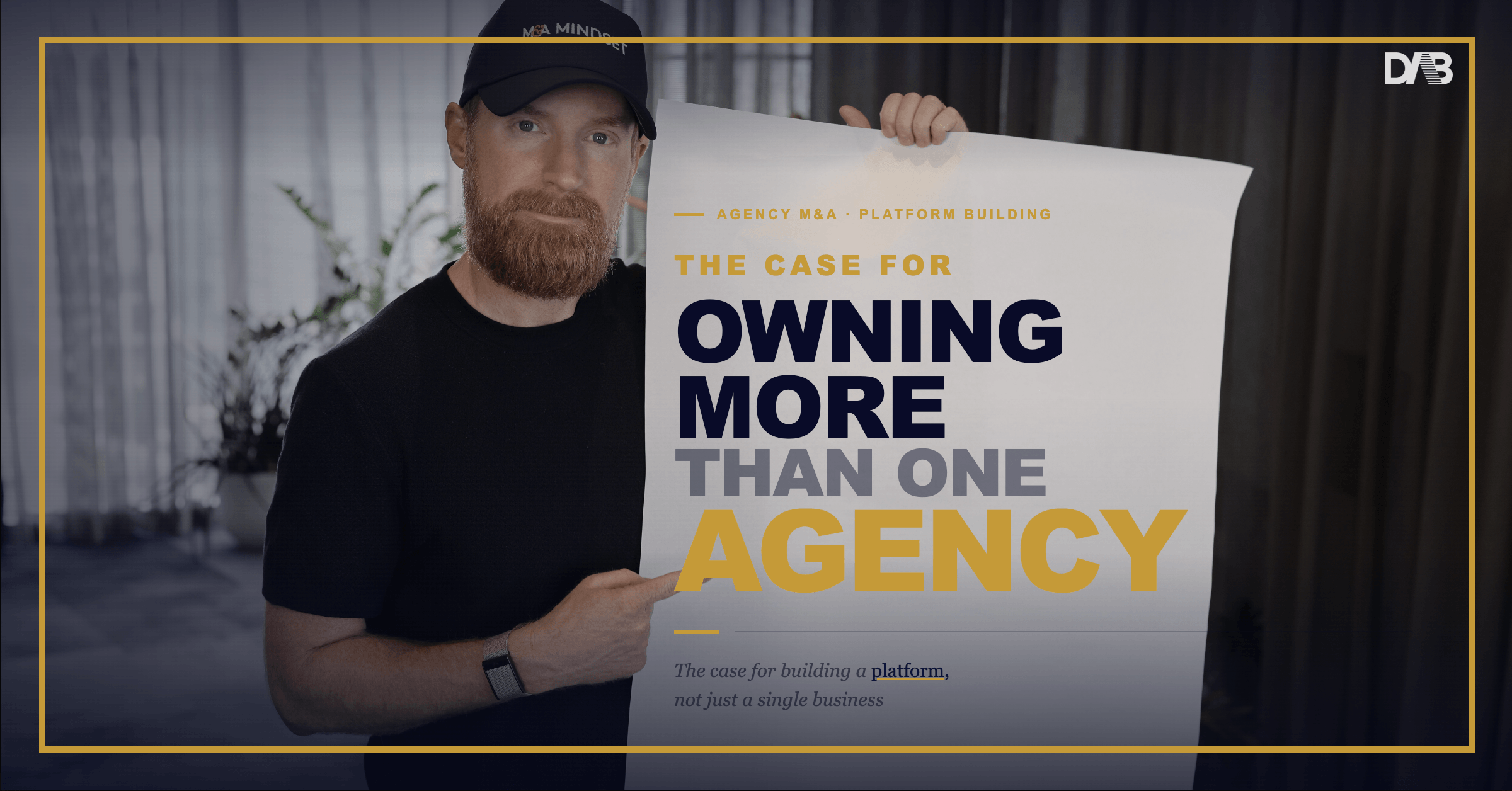
Owning more than one agency changes the math entirely. Not just the revenue math, the valuation math, the risk math, and the leverage math. Here's the actual case for building a platform instead of a single business, and what has to be true before you make the move.
Why One Agency Isn't Enough
1. Your Valuation Is Capped by Your Category
A single-service agency doing $1.5M in revenue sells at roughly 3-4x EBITDA, no matter how well you run it. That multiple isn't a reflection of your operational excellence. It's a reflection of the category you're in: single point of failure, single service line, single owner-dependent relationship structure.
A multi-agency platform with diversified services, diversified clients, and management depth beyond the founder sells at 6-7x EBITDA, sometimes higher. Same underlying profitability, nearly double the enterprise value. That gap doesn't come from working harder inside one business. It comes from owning more than one.
Pro Tip: Before you assume your agency is worth what a broker tells you, ask what multiple comparable multi-service platforms in your category are getting. The gap will tell you exactly what owning a second agency is worth to your eventual exit.
2. One Agency Means One Point of Failure
If your agency loses its biggest client, that's your whole quarter. If your best account lead leaves, that's your client retention at risk. If your niche softens, that's your entire revenue base exposed at once.
Owning more than one agency doesn't eliminate risk. It distributes it. A soft quarter in one business gets absorbed by a strong quarter in another. A key departure in one team doesn't threaten the whole platform. You stop being one bad month away from a crisis.
Watch-Out: Diversification only works if the businesses are genuinely independent operations with their own teams and client bases. Two agencies that share every key person and every major client aren't diversified. They're one business with two logos.
3. Your Capacity Stops Being the Ceiling
In a single agency, growth is bottlenecked by you: your time, your bandwidth, your ability to be in every important room. You can hire around some of that, but the business is still fundamentally shaped by what one owner can personally oversee.
A platform of two or three agencies, each with its own operator or strong management layer, grows independently of your personal capacity. You're not the ceiling anymore. The businesses can grow in parallel, each pursuing its own opportunities, while you allocate capital and attention across all of them.
4. You Unlock Cross-Sell You Couldn't Access Before
A single-service agency can only sell what it does. A platform can sell across capabilities. Your SEO agency's clients need paid media. Your creative studio's clients need a website rebuild. Your content shop's clients need social management.
None of that revenue exists inside a single agency, because a single agency doesn't have the capability to capture it. Every acquisition that adds a service line to your platform doesn't just add its own revenue. It opens a cross-sell channel into every client base you already own.
Pro Tip: Before your first acquisition, map your existing client base against what a second agency's services could sell into it. That overlap is often worth more than the acquired agency's standalone revenue.
5. It Gives You Real Leverage in Negotiations, With Sellers and Buyers
Owners of a single agency negotiate every deal, client contracts, vendor terms, eventually their own exit, from a position of "this is my only asset." Owners of a platform negotiate from a position of scale. You have more revenue to point to, more proof of integration ability, and more optionality if any single negotiation doesn't go your way.
That leverage compounds. The second acquisition is easier to finance than the first, because you have a track record. The third seller trusts you faster, because you can show them exactly how a previous acquisition was integrated and protected.
What Has to Be True Before You Add a Second Agency
Owning more than one agency isn't automatically better. A second agency you can't operate is just a second set of problems. Before you pursue it, three things need to already be in place.
- Your first agency needs to run without you in every seat. If you're still the one closing every deal and approving every deliverable, you don't have the bandwidth to integrate a second business. You have a job, not a platform.
- You need a management layer, not just employees. Someone needs to own operations day-to-day in your existing business before you can credibly take on a second one. Without that, every hour you spend on the new acquisition is an hour stolen from the business paying your bills today.
- You need capital and financing discipline. SBA financing typically covers 80-90% of a second acquisition too, but lenders will look hard at how your first business is performing. A stable, well-documented first agency isn't just operationally necessary, it's what makes the second deal fundable.
Watch-Out: The most common mistake among first-time platform builders isn't finding the wrong second agency. It's moving on the second deal before the first one is actually stable. An unintegrated first acquisition doesn't just stall, it makes the second one harder to close and harder to run.
The Real Question
Owning one agency well is a genuine achievement, and for some owners, it's the right place to stop. Not everyone wants to run a platform, and that's a legitimate choice.
But if the goal is building real enterprise value, not just a good income, the question isn't "how do I make my one agency bigger?" It's "what would this business be worth, and how much risk would I be carrying, if it weren't my only business?"
For most owners who ask that question honestly, the answer points toward a second acquisition, not a bigger version of what they already have.
Want a framework for evaluating whether your business is ready for a second acquisition? Get the FREE 21-Day Email Course built for agency owners thinking about scale.
Or join us live at the M&A & Exit Lab, where platform builders share exactly how they structured, financed, and integrated the deals that took them from one agency to several.
The platform is built one disciplined acquisition at a time. The only question is when you start the second one.